Why You Should NOT 'Dot and Dab' a Stone Patio
Our patio was laid on five dabs of mortar per slab instead of a full bed. What went wrong, what BS 7533 says, and why it brought ants and rats.
Several years ago we had a split-level stone patio laid by a local landscaping firm. We were away on business in Cambridge at the time and left the job in their hands, having asked for the many plant and holly bush roots to be removed before anything was laid.
When we got back the work was well under way: the hardcore was down and about two thirds of the slabs were already bedded. Several things were not what we had expected:
- The lower level had become a narrow path. The landscapers showed my wife that our three wheelie bins could go along it in single file.
- The new gate sat across two different levels, with a 500 mm drop on one side, and it opened outwards onto our neighbour's property.
- The upper level fell towards the house rather than away from it, and surface water drained through the gaps at the edge of the slabs into gravel-filled hardcore along our kitchen wall. It is a 1930s house with no damp-proof course.
We settled up with the firm at that point and I finished the job myself. I turned the narrow path into a small drying area, which let me rehang the gate on one level and put the bins wherever we wanted them, while still leaving room for a six-seater table on the upper level. I also added a step so the bins can go up there if needed. The fall of the upper level was the one thing I could not change.
Lifting slabs, ants and rats
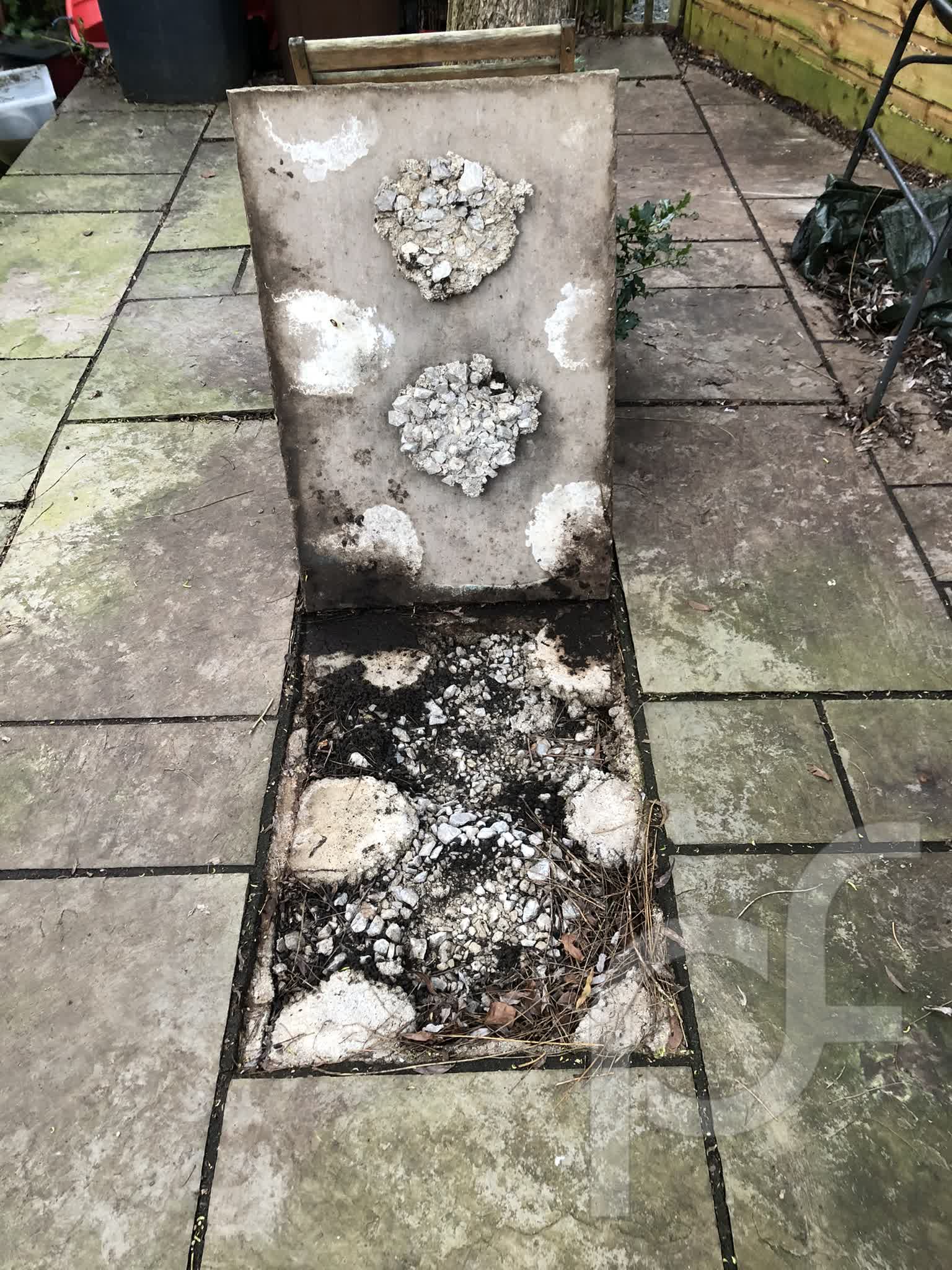
By May 2024 several slabs had started to lift, so I took one up to see why. This is what I found:
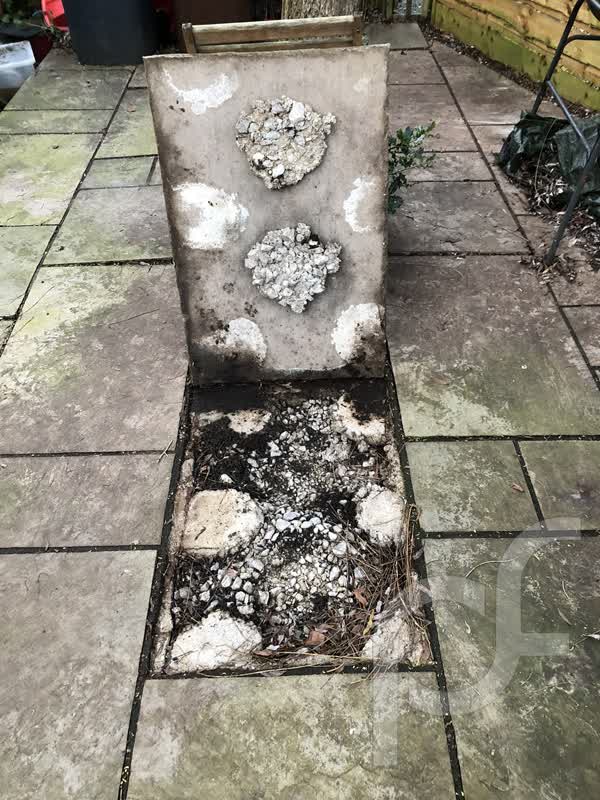
The slabs had been laid 'dot and dab': five dabs of mortar under each slab, sitting on hardcore, instead of a full bed of mortar. With so little support the slabs can sink and shift, and the hollow spaces underneath make an ideal home for ants and even rats. We have had both in the last three years, logged and dealt with by High Peak Borough Council. You can also see our old holly bush growing back up beside the slab.
What the British Standard says
British Standard BS 7533 Part 4, which covers laying concrete and natural stone flags and slabs, requires them to be laid on a "full bedding layer". That applies to every class of paving, patios and driveways included, not just large jobs in town centres and retail parks.
If you are having a patio laid
- Ask how the slabs will be bedded, and ask for a full mortar bed in line with BS 7533 Part 4.
- If you can, look before the slabs go down, or lift one early on.
- Check the fall: water should run away from the house, not towards it.
- Warning signs later on: slabs that rock or sound hollow when tapped, edges lifting, and ants nesting in the joints.
I am not a landscape gardener, but in my view this job needed little more than common sense. The slabs I laid to finish it are still rock solid, and yes, they are fully bedded!
Here are the girls inspecting my finished work: